Wednesday, 25 September 2013

The Iron Age 500 BC to 400 AD


The Iron Age is the period generally occurring after the Bronze Age, marked by the prevalent use of iron. The early period of the age is characterised by the widespread use of iron or steel. The adoption of such material coincided with other changes in society, including differing agricultural practices, religious beliefs and artistic styles. The Iron Age as an archaeological term indicates the condition as to civilization and culture of a people using iron as the material for their cutting tools and weapons.   
In historical archaeology, the ancient literature of the Iron Age includes the earliest texts preserved in manuscript tradition. Sanskrit literature and Chinese literature flourished in the Iron Age. The principal feature that distinguishes the Iron Age from the preceding ages is the introduction of alphabetic characters, and the consequent development of written language which enabled literature and historic record.
Iron Age Structures: Before discussing the types of artifacts produced during the Iron Age, it is worth setting the scene with some information on the structures that were in place at the time. The most common form of building were forts. The term fort indicates some sort of defensive structure but it is thought that this is ont necessarily the reason for the existence of these buildings. There are three types:
·         Ring forts
·         Hill forts
·         Promontory (a point of high land that juts out into a large body of water; a headland.) forts

Ring Forts


These forts consist of a bank made of earth surrounding a circular space. In Ireland they are often known by other names such as rath, dun, or cathair. In the east of Ireland the banks are chiefly made of earth, where as in the west where stone ifs more plentiful, stone walls were used to circle the fort. Ring forts were a communal dwelling place, housing a number of small wattle and daub huts. It is likely that the walls or banks were used to defend the people anf animals from wolves and wild animals rather than invaders.  


Tradition claimed that ring forts were "fairy forts" filled with Druids' magic and believers in the fairies did not alter them. The early pre-Celtic inhabitants of Ireland came to be seen as mythical and were associated with stories of fairies, also known as the "Good People". Fairy forts were seen as entrances to their world. Even cutting brush, especially whitethorn, on fairy forts was reputed to be the death of those who performed the act.


There are many folk tales about supernatural events happening at fairy forts. Real accidents which happened at ring forts could be given supernatural explanations. For example a man who tried to blast a dolmen suffered a septic hand. The wrecked dolmen was subsequently left untouched.


The destruction of two ‘fairy forts’ in Kilmurry, Co Cork, was punished this year by fines and penalties of €20,000, and followed a €25,000 fine for a farmer in Kerry for the same offence.  These cases show that fairy forts are sacrosanct, protected by cultural traditions entwined within Irish rural life. Sitting in the cab of a JCB, the bucket poised, a nagging doubt or a cold trickle of fear is a definite possibility for the farmer, who might think it safer to just let the land be; after all, a quarter acre is a small sacrifice for peace of mind. As rural Ireland changes, is this self-imposed ban failing? Owen Driscoll is an agricultural consultant in West Cork and has worked with thousands of farmers. Driscoll says this taboo remains. “I think that 99% of farmers would be very slow to cause damage to a fairy fort or even a fairy tree,” he says. “I don’t see any change in that with younger farmers. There is a sense that if you mess with the devil, then he may mess with you. “You will still be told stories of a farmer who damaged a fort or removed a whitethorn tree and then died within a short time, or suffered some other tragedy. For an older generation, the idea that fairies existed went beyond a belief. It was considered absolute fact.” 


 Hill forts:
 

These are plentiful in Ireland and, as the name suggests, are found at the top of hills. A hill fort is a type of earthworks used to secure refuge or defended settlement, located to exploit a rise in elevation for defensive advantage. They are typically European and of the Bronze and Iron Ages. Some were used in the post-Roman period. The fortification usually follows the contours of a hill, consisting of one or more lines of earthworks, with defensive walls, and external ditches. Hill forts developed in the Late Bronze and Early Iron Age, roughly the start of the first millennium BC.
  
 Promontory Forts


These forts are found in two locations – on the edges of cliffs and high on a spur of a mountain. A promontory fort is a defensive structure located above a steep cliff, often only connected to the mainland by a small neck of land, thus utilizing the landscape to reduce the defensive walls needed. Although their dating is problematic, most seem to date to the Iron Age. They are mainly found in Ireland, the Orkney Islands, the Isle of Man and Cornwall. Only a few Irish promontory forts have been excavated and most date to the Iron Age, though some, like Dunbeg (County Kerry) might have originated in the Bronze Age.


Bog bodies


The mummified remains of a body found in a Laois bog two years ago have been found to date back to 2,000BC, making it the oldest “bog body” discovered anywhere in the world. The 4,000-year-old remains, which predate the famed Egyptian pharaoh Tutankhamun by nearly 700 years, are those of a young adult male. He is believed to have met a violent death in some sort of ritual sacrifice. The body was unearthed in the Cúl na Móna bog in Cashel in 2011 by a Bord na Móna worker operating a milling machine. Initially, experts thought it dated from the Iron Age period (500BC-400AD), placing it on a par with similar finds in other Irish bogs.
However, radiocarbon tests on the body; the peat on which the body was lying; and a wooden stake found with the body, date the body to the early Bronze Age, around 2,000BC.
The discovery promises to open a new chapter in the archaeological record of Bronze Age burial in Ireland. He said the remains are those of a young adult male which were placed in a crouched position and covered by peat, probably on the surface of the bog.

The man’s arm was broken by a blow and there were deep cuts to his back which appear to have been inflicted by a blade, which indicate a violent death, Mr Kelly said. Mr Kelly believes the wounds on the body, combined with the fact that it was marked by wooden stakes and placed in proximity to an inauguration site, point to the individual being the victim of a ritual sacrifice. “It seems to be same type of ritual that we’ve observed in later Iron Age finds. What’s surprising here is that it’s so much earlier.” Because of the lack of calluses on the hands and the well-groomed fingernails observed in other finds, though not this one as the hands were not recoverable, Mr Kelly suggests the victims were most likely “high-born”. “We believe that the victims of these ritual killings are kings that have failed in their kingship and have been sacrificed as a consequence.” The chemical composition of bogs can preserve human bodies for thousands of years. Archaeologists have discovered more than 100 ancient bodies in Irish bogs but few as well-preserved as “Cashel man”.


The Arrival of the Celts


As the Bronze Age in Ireland drew to a close, there appeared in Ireland a new cultural influence. Developing in the Alps of central Europe, the Celts spread their culture across modern-day Germany and France and into the Balkans as far as Turkey. They arrived in Britain and Ireland around 500BC and within a few hundred years, Ireland's Bronze Age culture had all but disappeared, and Celtic culture was in place across the entire island.
Iron had been introduced to the Celtic peoples in Europe around 1000BC to 700BC, thus giving them the technological edge to spread as they did. Iron was a far superior metal to bronze, being stronger and more durable. On the other hand, it required much hotter fires to extract it from its ore and so it took a fair degree of skill to use iron. None of this is to be taken to mean that bronze fell out of use. Rather, iron simply became an alternative metal and many bronze objects have been found that were made in the Iron Age.


Everyday Life in Celtic Ireland:


Much of what we know about specifically Irish culture has come down through the years in the form of Heroic Tales, such as the Ulster Cycle which tells of the exploits of
Cú Chulainn, the Hound of Ulster. Once thought to be historically unreliable, these Heroic Tales describe a way of life that fits well with what we now know about the Celts of mainland Europe. Thus it seems that, while the events described may have been embellished over the years, the underlying themes and props in the stories may be accurate descriptions of life in Iron Age Ireland.


It was, in many ways, a culture based around war. Ireland was divided into dozens - possibly hundreds - of little kingdoms. Within the kingdoms, it was the blacksmiths, druids and poets who were held in high esteem: the blacksmiths for making the weapons of war, the druids for making prophesies and soothsaying (the art or practice of foretelling events), and the poets for putting the exploits of warriors to verse, to be sung around the cooking fires. The aristocracy (a form of government in which power is in the hands of a small, privileged, ruling class) in this culture was made up of the warriors, who sought fame and recognition by doing battle with their enemies. The young warrior would be initiated by mounting his chariot (a two wheeled wooden cart pulled by two horses), before proceeding to battle and cutting off the heads of his enemies to bring them home as trophies. At the celebratory banquet afterwards, the warriors would compete for the "hero's portion" of the food being served. The weapons brandished by these warriors consisted of round wooden, bronze or iron shields, with iron spears or swords. The spear seems to have been more common than the sword.


Brehon Law 

The law that the Celts of Ireland used has been called Brehon law. Forms of Brehon Law were used in Ireland for hundreds of years. The idea was that a person's identity was defined by the kingdom in which they lived. A peasant had no legal status outside the tuath, with the exception of men of art and learning. Those who were tied to their tuath were unfree and worked for the king. All land was owned by families, not by individuals. Wealth was measured in cattle, and each individual had a status measured in terms of wealth. Almost any crime committed against an individual could be recompensed by paying a fine equal to the status of the individual. For example, a 50 cows for an important person, 3 cows for a peasant. There was no death penalty; but, an individual could be ostracised from the tuath in certain circumstances.


Contemporary Use of Bronze Age Technique and Style

Contemporary Use of Bronze Age Technique and Style


Sample Answer - Bronze Age

SAMPLE ANSWER - HIGHER LEVEL, 2008, 
QUESTION 2

“Irish Bronze Age gold artifacts reflect both the design skill and craft skill of their makers. Discuss this
statement with reference to form, function, decoration and metalworking techniques of any two named
gold objects from this period AND Write a brief account of the Bronze Age people in Ireland and on their sourcing of raw materials for their gold artifacts”

1.
MARKING SCHEME FOR HIGHER LEVEL, 2008, QUESTION 2
Names 5
Discussion of example 1
Form, function, decoration and metalworking techniques 15
Discussion of example 2
Form, function, decoration and metalworking techniques 15
Brief account of Bronze Age people, sourcing of raw materials 5
Sketches 10
Total 50

Intro
There are many beautiful gold artifacts which date back to the bronze age including Lunalae, Torcs and
Lock Rings, however, the two gold objects which I feel best encapsulate the design and craftsmanship
skill of the bronze age metalworker are the Golden Dress Fastener, or Fibula, and the Gleninsheen
Golden Gorget.

These two artifacts date back to the Late Bronze Age, between 900 and 700 B.C.. The dress fastener, or
Fibula as it was also known, was found in Clones in County Monaghan in 1820 and the Golden Gorget
was found in Gleninsheen in County Clare in 1932. THe two artefacts exemplify and reflect both the
design skills and craft skills of their creators.

Form

The Dress Fastener is a very simple concept. It consists of three basic shapes: a hollow handle and two
hollow terminals. e handle is attached to the terminals, which are conical in shape. They are very
large and heavy and weigh approximately 1,300 grams.
The Gleninsheen Golden Gorget is slightly more complex in form. the gorget, also known as a collar, is
a crescent-shaped necklace with a decorated disc on each end. It is constructed from five parts; the
crescent shape in the middle attached to two double discs at either end. the ends of the crescent are
pushed through a slot in the lower disc and stitched together. A slightly larger disc was then placed over
the lower disc and the edges are curled over to cover it.

Function

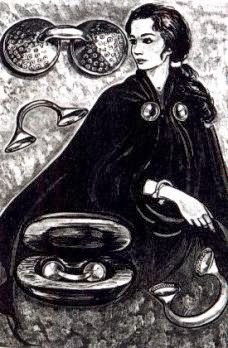
The Golden Dress Fastener was used as a double button which could be inserted into slits in a cloak to
hold the edges together. e terminals are thought to have been inserted by the wearer into large
buttonholes on a cloak or robe. ey would have been a sign of great power and wealth and it is likely
that they would only have been worn at ceremonial functions as a symbol of the wearer’s superior social
class.
The golden gorget similarly symbolised the high rank of the owner and was probably only worn at
ceremonial occasions too. They would have originally been fastened around the neck by a cord which
was linked to the ends of the collar.

Decoration

The dress fastener is thought to be of a Scandinavian design. The edges of the terminals are decorated
with rows of raised lines. On the terminals themselves are several concentric circles, each with a raised
bump in the center. On the join of the terminals and the handles are rows of parallel lines with a border
of hatched zigzags.
The Gleninsheen Golden Gorget is an outstanding piece of early Irish craftsmanship, bringing together
many decorative motifs typical of the Bronze Age. These included concentric circles, rope patterns and
raised bosses, both round and conical. There are eleven concentric circles placed around the main large
central concentric circles on the discs. Six molded rope patterns decorate the collar itself. In the center
of the two discs are conical bosses. Round bosses can be seen around the edges of the discs and the
collar. A smaller pattern of round bosses encircle the central concentric circles on the discs.

Metalwork Techniques

The actual form of the Golden Dress Fastener was made by hammering sheets of gold, and soldering
them together. The designs on the dress fastener were made using two metalwork techniques: incision
and repoussé. Incision is when the design is notched or scored onto the surface of the object this
method can be seen in the incised concentric and in the incised decoration of parallel lines and hatched
zigzags situated at the join of the terminals with the handle. The second technique, repoussé, is when
the design is hammered or punched out from the reverse side of the artifact. This method can be seen
in the raised bumps in the center of the concentric circles.
The same techniques were used in the decoration of the Gleninsheen Golden Gorget. The rope
moldings found on the crescent of the collar, and the raised bosses on the discs are an example of
repoussé. An example of the incision techniques would be the concentric circles found on the discs.


Bronze Age People

The Bronze Age people used a series of steps to retrieve the mineral ore from the rocks. First, they lit a
"re to expand the substance of the rock. They then threw cold water over the rock, causing the rock to
shatter due to the rapid change in temperature. Stone implements were then used to break down the
pieces of rock further. The small fragments of rock were then smelted down to free the metal. Different
rocks were used to extract different raw metals which were found at various locations around Ireland.
For example, copper was found at Cork, silver at Silvermines, and gold and lead were found in
Wicklow.

Bronze Age Ireland


Bronze Age Ireland

Early Bronze Age – 1800B.C to 1500 B.C
Middle Bronze Age 1500 B.C to 1200 B.C
Late Bronze Age 1200 B.C to 500 B.C 

     
The prehistory of Ireland has been pieced together from archaeological and genetic evidence; it begins with the first evidence of Mesolithic hunter-gatherers settling in Ireland after 8000 BC and finishes with the start of the historical record, around AD 400. The prehistoric period covers the Mesolithic, Neolithic, Bronze Age and Iron Age societies of Ireland. For many European countries a historical record begins when the Romans invaded; however, as Ireland was not invaded by the Romans its historical record starts later, with the coming of Christianity.

  • Mixing copper and tin to make bronze – more usable and durable than copper
  • Ireland was blessed with relatively rich copper deposits, allowing large quantities of bronze to be produced on the island. 
  • Movement of people throughout Europe – bringing new cultures, skills and customs to Ireland.
  • Most of the tin that was needed to make the bronze seems to have been imported from what is now England.

Four Distinct Groups:
  1. The Beaker People                          3. The Bowl Food Vessel People
  2. The Food Vessel People                4. The Urn People

EARLY BRONZE AGE
The Beaker people were late Neolithic–Early Bronze Age people living about 4,500 years ago in the temperate zones of Europe.

Bell Beaker People & Beaker Pottery

Form:
The Beaker people get their name from the shape of the pottery that they made. The pots are usually V shaped in section like an upside down bell. Narrow at the bottom and opening out toward the top. Pots were usually 10cm to 20cm tall.
Decoration:

The whole outer surface usually covered with ornate decoration, made by a toothed comb or wheel which produced dotted lines often running parallel to each other. Motifs include herringbone, chevrons and lozenges; bases are sometimes decorated with a cross. The pots usually have raised bands in high relief – a light/shadow effect created by the use of chip carving
Function:
The pots were used as funerary vessels. The ashes of the dead may have been placed in them or the pots may have been placed beside the dead containing food as sustenance for their journey to another world.
Technique:
The pots would have been made using a clay coiling technique. Long sausages of clay would be rolled out and then coiled around slowly building upward. The surface would then be smoothed and rendered with clay working tools.


Bronze Age
      
Wedge Tombs


Wedge Tombs consist of a narrowing stone chamber covered by a mound of earth. The single entrance almost invariably faces south-west.

They are found in western Ulster, Connaught and Munster

A wedge-shaped gallery grave or wedge tomb is a type of Irish chamber tomb. They are so named because the burial chamber itself narrows at one end (usually decreasing both in height and width from west to east), producing a wedge shape in elevation.
A distinguishing characteristic of wedge tombs is the double-walling of the gallery. They were often covered by cairns, which could be round, oval or D-shaped, often with a kerbstone to fasten it down. More are low sized, usually about 1.5 metres high, and are generally found on mountainsides, about three-quarters the way up.
Wedge tombs were built between the Irish late Neolithic and middle Bronze Ages (about 2500 to 2000BC). Today, between 500 and 550 known wedge tombs survive in Ireland, and are found predominantly in the West and North West of the island.
                                       

These monuments added social dimensions to the landscape and over time they became permanent, integral part of the landscape. People became engaged in the landscape and the monuments they built became a focal point for their activities.


Housing 


It seems that the Bronze Age Irish lived in houses that were similar to those of the Neolithic; that is, rectangular or circular houses constructed from timber beams with wattle-and-daub walls and thatched roofs made from reeds. The circular houses would have been from 4 to 7 metres in diameter and supported by a central post. Some other houses may have been constructed from sods of earth placed within a wooden frame. Many houses would have had a circular wooden fence making an enclosure in front of the house. There was sometimes a circular ditch around the whole property which was both defensive and kept animals in. 


Agriculture
          

Agriculture continued much as it did in the Neolithic, on a larger scale. More lowland forests were cleared to make farmland which was used for grazing or for growing cereal crops.  

Cooking


Bronze Age cooking place or fulacht fia was horse-shoe shaped. A wood-lined trough was dug in the ground and filled with water. Beside the trough, a fire was lit and stones heated in the fire. These stones were then thrown into the water. Once it was hot enough, meat could be boiled in the water. The broken, used stones were hurled off to one side and formed, over the course of some years, the distinctive horseshow mound. 1200bc - 500bc


 EXTRACTING ORE FROM ROCK


Evidence from inside the mines indicates that the copper ore was probably extracted by lighting fires inside the mine and then, when the mine walls had become hot, water was splashed onto them, thus shattering the ore which could then be removed. Counties Cork and Kerry, on the south-west tip of the island, produced the bulk of Ireland's copper and it has been estimated.

Ireland exported a lot of copper during the Bronze Age.


Series of steps extracting ore from the rock

  1. Light a fire to expand the substance of the rock
  2. Throw cold water over the rock – quick cooling causes it to shatter
  3. Break down the rock further
  4. Small fragments of rock and mineral ore were smelted down to free the metal
                                      

The technology for moulding the bronze improved through the Bronze Age. Initially, items were cast by pouring the bronze into a hollowed out stone. When removed, this axe head would have been attached to a wooden handle at its narrow end, while the wide, curved end would have become the blade.


By the middle Bronze Age, people had invented two-part moulds  where two hollowed stones were put together and metal poured into a gap at the top. This allowed more complex items, such as daggers, to be produced.

By the end of the Bronze Age, people were making wax or fat models of what they wanted to cast, putting clay round them and then heating the clay to melt the wax. They then poured in the metal and chipped away the clay once it had set.

The Bronze Age also saw the first use of gold and there are a number of beautiful examples of gold jewellery and other objects. As gold was useless for any practical purpose, and also because of its beautiful colour and rarity, it quickly became a highly desirable ornamental material. It is for this reason that the period is sometimes called Ireland's first "golden age"


 Metalworking Techniques

Three main metalworking techniques of the Bronze Age Period:

1.    Repoussé - Design beaten in from the back.


Name: Sun Discs
Found: Co. Monaghan – Early Bronze Age
Form: Discs of thin gold, often found in pairs, 11.6cm in diameter
Decoration: Chevrons, zigzags, geometric designs consisting of two rings of chevrons, surrounded by multiple rings of indentations. In the middle of the disc there is a cross with a star like feature at the centre.
Function: Stitched onto garments – It was worn as a representation of wealth or status. The two holes in the middle show that it was possibly sewn onto clothing. Often found in pairs and possibly worn on the chest.
Technique: Circle beaten from plate of gold – decorated by hammering and punching
2.    Incised - Design cut into.


Name: Lunulae
Found: Co. Westmeath – Early Bronze Age
Form: Crescent or half – moon. 20cm across
Decoration: Geometrical patterns consisting of chevrons, zigzags. Toward the narrow ends there are four bands of lozenges and zigzags. The outer edge of the whole piece is decorated with lines and lozenges.
Function: Jewellery, worn as a sign of wealth and status around the neck.
Technique: Cut from thin beaten sheets of gold with slightly thicker extensions at the ends for locking. Gold would be hammered till very thin and then cut into the crescent shape. Decoration would be applied using the incision technique.


3. Twisting- Metal twisted.


Name: Gold Ribbon Torc
Found: Belfast, Co. Antrim – Late Bronze Age to Golden Age
Form: Cylindrical bands of gold which are not completely closed.
Decoration: Thin ridges of geometrical patterns flowing around the band. The outer edge of the piece has a raised lip.
Function: Jewellery worn to show wealth and status. These would be worn on the wrist, arm or neck. The design could possibly have originated from protective armour worn by warriors.
Technique: Gold would be hammered until very thin and then cut into a rectangular shape. Then decoration would be applied using the repousse technique. The gold sheet would then be bent around a cylindrical form.
Pre-Christian Ireland In Ireland we split the Bronze Age into three distinct periods


Torcs


Form: Long twisted gold flanged torc with elaborate hook like clasps.

Function: Worn as jewellery around the waist perhaps used to fasten clothing. They were worn as sign of status and wealth.

Decoration: The decoration is attained through the twisting of the flanged gold bar.

Technique:  Firstly a square sectioned piece of gold bar would be hammered out. Then the flat faces of the bar would be hammered to emphasise the corners creating flanges. The bar was then twisted to create the design. The hook clasps were rounded and bent into shape of the design.


Long gold bar torcs
Period : Middle bronze age


Form: Twisted flat gold bar with hook clasps to fasten the piece.

Function: Worn as jewellery around the neck as a sign of status and wealth.

Decoration: Decoration is attained through the uniform twisting of the flat gold bar.

Technique: Firstly a piece of gold would be hammered into a flat thin rectangular strip. The strip would then be twisted uniformly to create the ribbon effect. The ends of the strip would be hammered into rounded hooks for fastening.

Ribbon Torc from Belfast 1400bc - 1200bc is known as the Bishopslands Phase. It gets its name from a great hoard of bronze artefacts dating from around 1400bc - 1200bc found in Bishopsland in Co Kildare. At around this time much of the sheet gold work of the early Bronze Age was replaced by Torcs, ornaments and jewellery made from twisting bars of gold.

Late Bronze Age
Fibula


Form: Two disc or cup like shapes joined together with a gold bow or handle made from approx 1kg of gold.

Function: It is most likely worn as a dress fastener. Due to the weight of this fibula it was not practical for everyday wear and was probably reserved for ritual.

Decoration: The surface is finely polished. There are four rows of concentric circles on three quarters of the cup surfaces containing a single punch mark at each center  The surface of the cups underneath the bow is undercoated but polished. The perimeters of the cups are decorated with rings in a step like fashion where the bow joins the cups there are chevrons and parallel lines encircling it. The bow itself is finely polished without design.

Technique: The piece was cast using the lost wax method. In Bronze Age times animal fat may have been used instead of wax. After casting the piece would have been polished before the designs were made using the incision technique.


Late Bronze Age
Gorget


Form: Crescent shaped gold sheet with two attached concave (bowl shaped) gold discs.

Function: Jewellery worn around the neck as a sign of wealth and status.

Decoration: The crescent shaped part is highly decorated with six repousse ridges of rope with rows of beads on either side. The edges are folded backwards to give a clean border. The outer edge of the discs is decorated with repousse beading. There is a row of incised concentric circles with dot marks at the center. At the center of the disc is a large repousse point surrounded by dozens of incised concentric circles followed by rows of repousse beads.

Technique: Firstly gold was hammered in a thin sheet and then cut into the crescent and disc shapes. The discs were hammered into a concave shape. The decoration was added using both the incision and repousse technique before joining the pieces together using a type of biscuit joint and securing with gold wire.
 Biscuit Joining 


Late Bronze Age
Lock Rings


Material: Gold

Form: Each lock ring consists of two cone shapes of thin gold wire fixed together at the wide end with a pinched narrow bronze sheet creating a ridge. A slit is cut into the form from edge to center. At the center is a cylindrical piece of sheet gold that can rotate freely.

Function: These were probably worn as hair ornaments by a wealthy or powerful member of society. A lock of hair could be pushed through the slit of the cone and the aligned cylinder. The lock of hair could be fixed in place by rotating the cylinder out of alignment.

Decoration: Decoration of the piece is achieved in the very thin and delicate spiral created by this gold wire as it spirals from the center of the cones outward. The edges of the pieces are polished.

Technique: The cones were made by coiling thin gold wire over a cone form. The wire was soldered together to create a rigid cone structure. Each cone was then cut to allow for the slit. The cones were joined together with a band of sheet gold pinch around the edges. A cylindrical tube also with a slit was placed at the center and can move freely. The band and the cylinder were made from gold which was hammered into a sheet and cut to size.


Late Bronze Age


Material: Bronze

Form: Large round cooking pot with large rim and loop handles, 40cm high by 60cm wide.

Function: Used for cooking large quantities of food. A pole may have been put through the handles to suspend the pot over flame and to assist in carrying of the full pot.

Decoration: The structural rivets in the pot are the only decoration on the vessel.

Technique: The pot is made from sheet bronze. Many separate sheets are riveted together. Riveting is done by putting a pin through a hole in both sheets and hammering the rivet from both sides until flattened and rounded, holding both sheets securely.